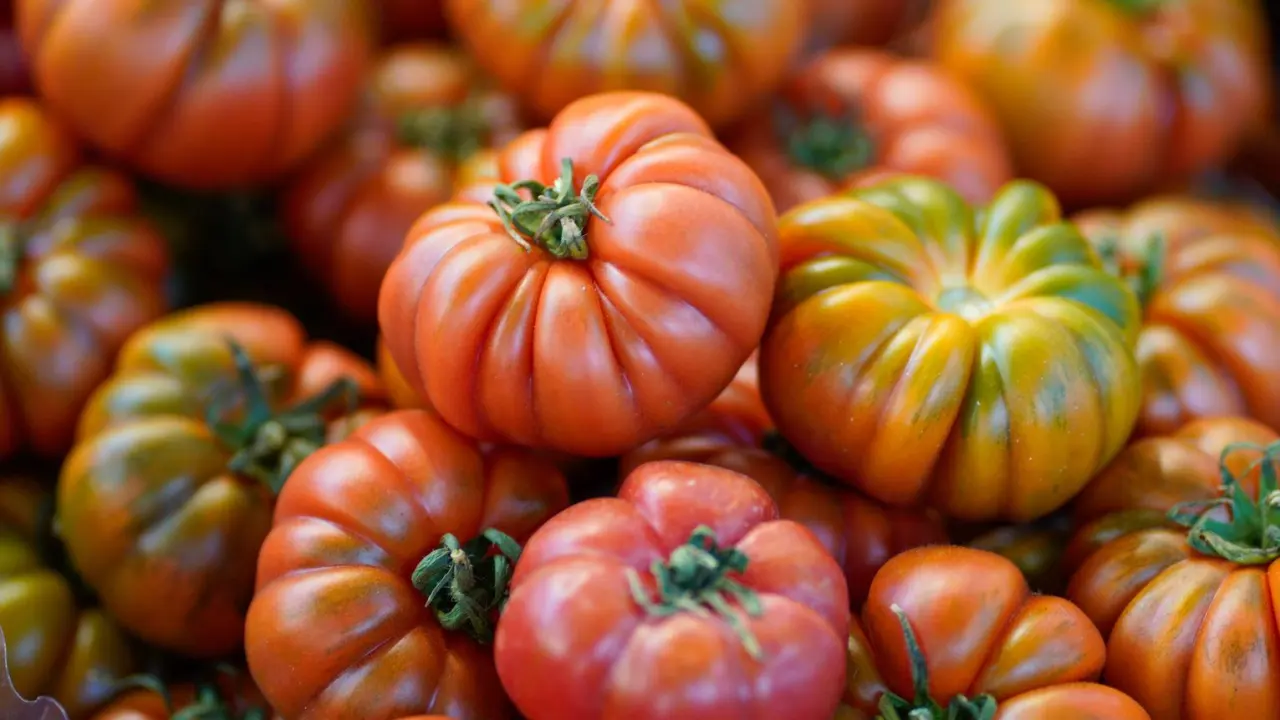
Unsure what to buy at a market table of lumpy, striped, purple-shouldered tomatoes? The heirloom tomato varieties you see there are open-pollinated types with a documented story, often more than 50 years old, prized by many gardeners for flavor over tidy looks.
For the bigger picture, read about fresh produce at farmers markets.
| Item | Value |
|---|---|
| Common heirloom age rule | More than 50 years of documented lineage |
| Brandywine | 12 oz., 80 days to harvest |
| Cherokee Purple | 11 oz., 82 days to harvest |
| Striped German (largest in this guide’s table) | 24 oz. |
| Stupice (earliest in this guide’s table) | 3 oz., 60 days to harvest |
These figures come from Iowa State Extension and Colorado State Extension. They can change, so check the sources before you rely on them.
What makes a tomato an heirloom?
There is no universal definition of an heirloom tomato, according to Iowa State Extension. Many agree they are cultivars with a story or documented lineage developed more than 50 years ago, although a newer tomato can be called an heirloom if it has a story.
Colorado State Extension splits the idea into two kinds, and adds the seed rule that sits behind both:
- Commercial heirloom: an open-pollinated variety introduced before 1940 or in circulation for more than 50 years.
- Family heirloom: a variety passed down for several generations through a family.
- Open-pollinated: seeds produce plants and fruit identical to their parent.
You can read the definitions on the Colorado State Extension tomato page. The story matters as much as the age.
Iowa State’s example is Cherokee Purple, which originated from tomatoes grown by the Cherokees more than 100 years ago. It was shared with Southern Exposure Seed Exchange by John Green of Sevierville, Tennessee, in 1990, as the Iowa State Extension page explains.
Heirloom tomato varieties by shape, size and color
Tomatoes are often sorted by fruit shape, and the labels help at a stand. Iowa State describes three that matter most for heirlooms:
- Beefsteak: large fruit, sometimes more than one pound, with dense flesh and numerous small seed cavities.
- Salad: small, bite-sized fruit in shapes including cherry, grape and pear.
- Paste: small to medium fruit, often oblong, with thick flesh and small seed cavities that suit sauces and tomato paste.
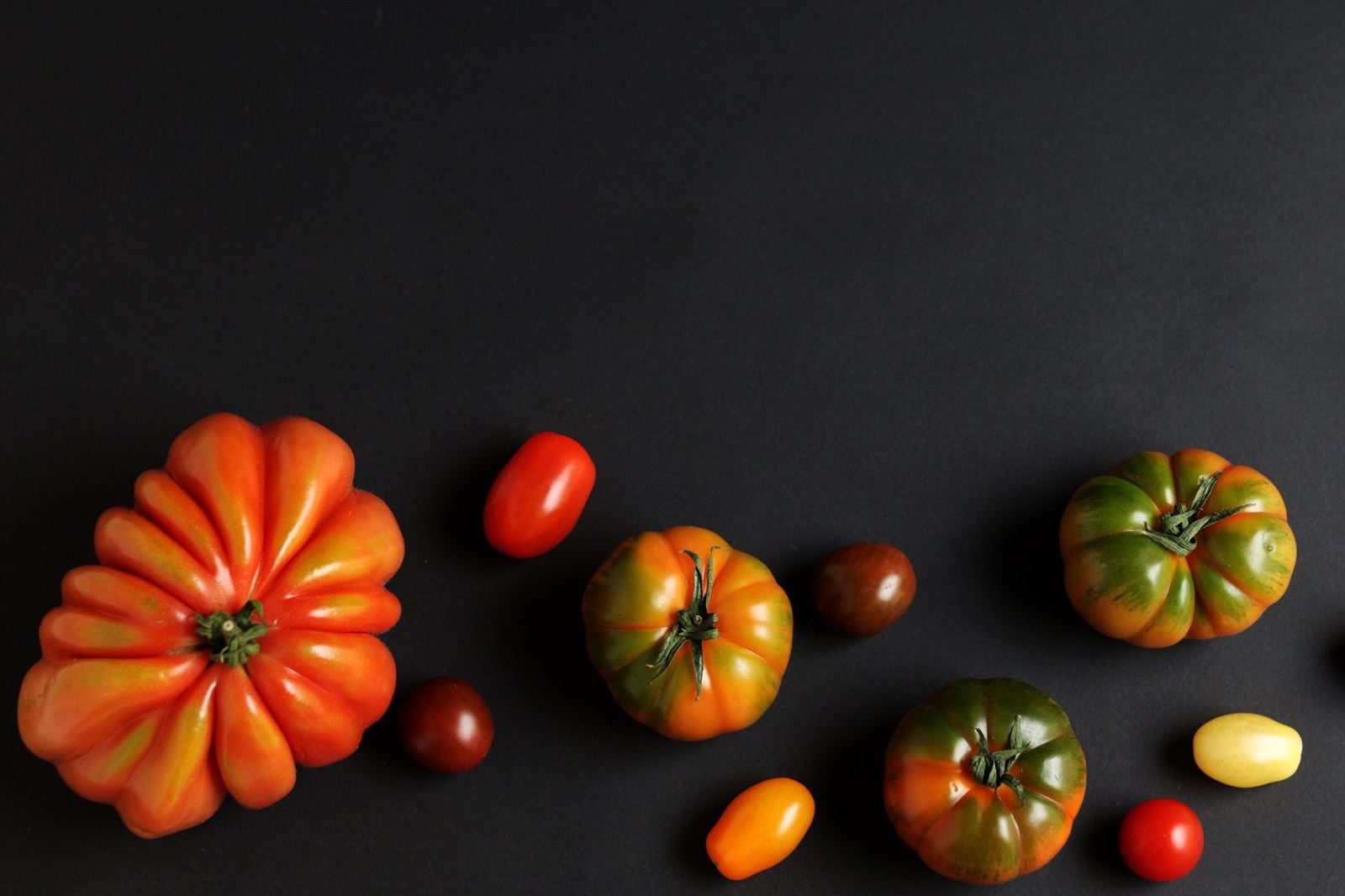
Color is where heirlooms show off. The Iowa State list includes red, pink, yellow, purple, orange, green, black, white, rose, golden, bi-color and multi-color fruit.
The table below pulls a dozen open-pollinated heirlooms from the Colorado State Extension tomato list. Colors follow that list, so a variety can read differently elsewhere: Iowa State describes Cherokee Purple as rose-purple.
| Variety | Type and size | Color | Days to harvest |
|---|---|---|---|
| Brandywine | Deep globe, 12 oz. | Pink | 80 |
| Cherokee Purple | Slight flat, 11 oz. | Pink | 82 |
| Mortgage Lifter | Beefsteak, 15 oz. | Pink | 95 |
| Black Krim | Rough globe, 8 oz. | Red | 75 |
| Pineapple | Beefsteak, 12 oz. | Yellow | 90 |
| Striped German | Beefsteak, 24 oz. | Bicolor | Mid-season |
| Green Zebra | Round, 3 oz. | Green | Late season |
| Stupice | Globe, 3 oz. | Red | 60 |
| Coure di Bue | Oxheart, 9 oz. | Red | 85 |
| Beam’s Yellow Pear | Pear, cherry | Yellow | 75 |
| Amish Paste | Acorn, 8 oz. | Red | 82 |
| San Marzano | Elongated, 5 oz. | Red | 80 |
Figures in this table come from the Colorado State Extension tomato page and can change, so check it before you rely on them. Days to harvest are generally counted from the time transplants go into the garden, and the page groups them as early (under 69 days), mid-season (70-80 days) and late season (over 81 days).
Heirloom versus hybrid: what you trade off
Many gardeners believe heirloom flavor is better than that of modern hybrids developed primarily for commercial production and long-distance shipping, per Iowa State Extension. The same page is candid about the cost. Heirlooms tend to be less productive and more susceptible to many diseases and disorders.
Here is how the differences show up for a shopper:
- Looks: the Farmers’ Almanac says an heirloom harvest can look mixed and even a little homely, with green shoulders, pink streaks and yellow blushes.
- Seeds: heirloom seed grows true to type the following year, while seed from a hybrid will not resemble the parent.
- Age: many heirlooms trace back 100 or more years, and the same Almanac page says Brandywine dates to the 1880s.
- Genetics: neither type is a GMO, because both come from ordinary pollination rather than laboratory gene editing.
The Almanac also lists farmers markets, along with specialty seed companies, as a place to find heirlooms, and calls them less common in mainstream retail. That is the main reason a market stand is where you will meet the odd shapes and colors.
How to choose and use heirlooms at the market
A few habits make the stand easier to read. Work through them in order:
- Ask for the variety name. A name such as Brandywine or Amish Paste tells you more than “red” or “pink”.
- Do not judge by color alone. Green shoulders and streaks are normal on many heirlooms, as the Almanac explains in its hybrid versus heirloom guide.
- Match the shape to the job. Paste types have thick flesh that suits sauces, beefsteaks are the big slicers, and small pear or cherry types are bite-sized.
- Ask how long a variety has been coming in. Iowa State Extension says the harvest period of indeterminate plants often extends over two to three months.
Once you are home, read up on how to wash farmers market produce before you slice into your haul. If peaches are in the same basket, learn how to ripen peaches at home too.
Frequently asked questions
Are heirloom tomatoes genetically modified?
Show answer
No. The Farmers’ Almanac says neither hybrids nor heirlooms are GMOs, because both result from ordinary pollination rather than laboratory gene editing.
Can I save seeds from an heirloom tomato?
Show answer
Yes, with one caveat. Iowa State Extension says open-pollinated seed grows true to type the following year, provided it is not crossed with a different cultivar nearby.
How old does a tomato have to be to count as an heirloom?
Show answer
There is no universal rule. Many agree on a documented story and development more than 50 years ago, and Colorado State’s commercial heirloom definition uses the same 50-year mark or an introduction before 1940.
Which heirlooms suit sauce?
Show answer
Look at paste types. The Colorado State list includes Amish Paste (8 oz.) and San Marzano (5 oz.) among its open-pollinated plum and paste varieties, as shown on its tomato page.
Why do heirlooms look so uneven?
Show answer
Heirlooms were not bred for the uniform red of many modern tomatoes. The Farmers’ Almanac says they lack the deep red color that many modern tomatoes were bred to have, so the ripening plant does not spend its energy making that uniform red.